

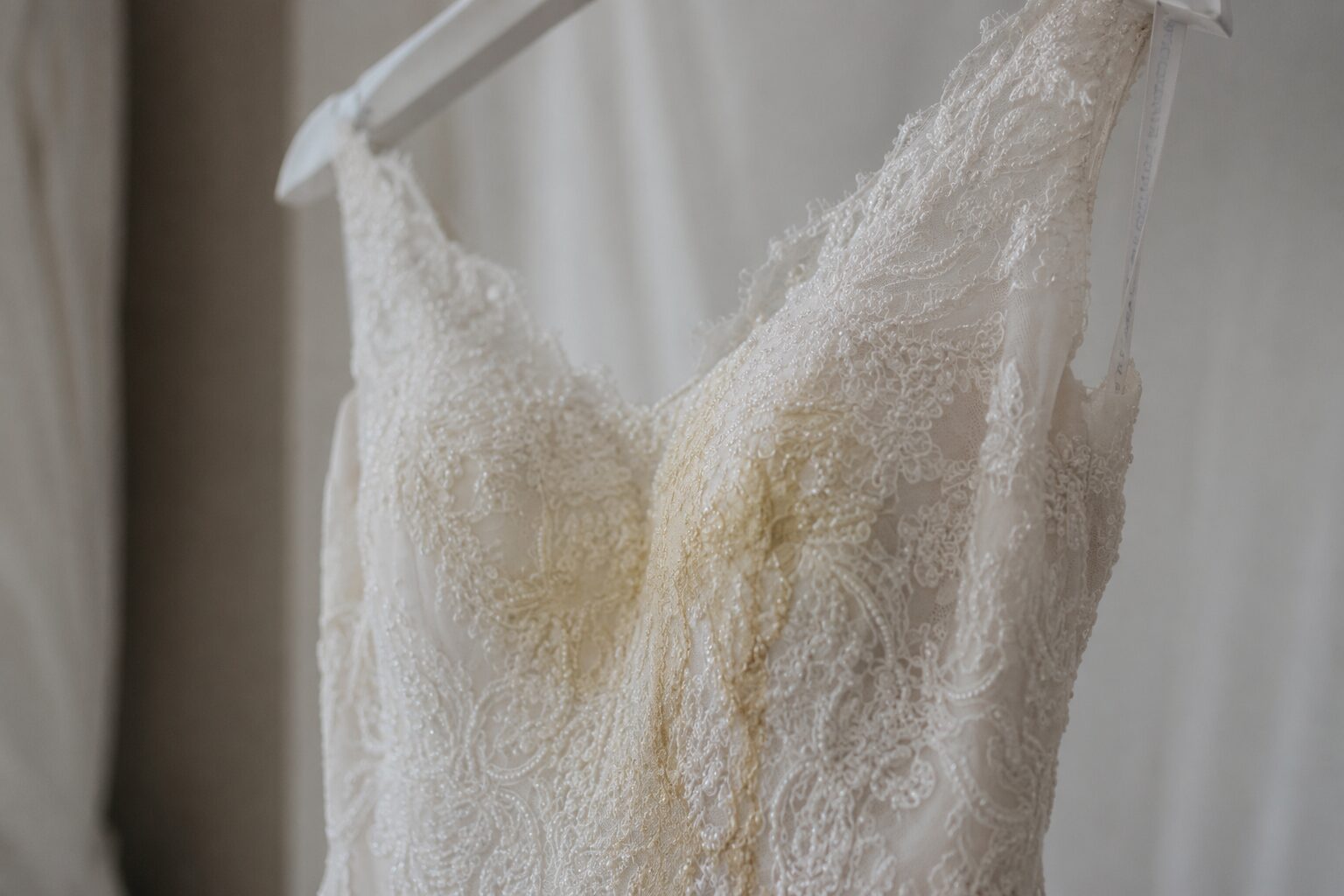
You open the box or unzip the garment bag, expecting to see your dress exactly as you left it. Instead, the ivory or white that looked perfect on your wedding day has a visible yellow cast. Maybe it has been a year. Maybe it has been five.
Here is what you need to know before you spiral: this is chemistry, not carelessness. Wedding dresses turn yellow, whether they are stored for twelve months or twelve years. Shreveport’s humid Louisiana climate accelerates every one of those chemical processes, which is why so many brides here notice the change sooner than they expected.
This post explains exactly why it happens, what can realistically be recovered, and what to do next. You will leave here with a clear action plan, not more anxiety.
Why Do Wedding Dresses Turn Yellow? The Three Main Causes
Most yellowing comes from one of three sources. Identifying which applies to your dress helps a professional cleaner treat it correctly.
Cause #1: Invisible Sugar Stains That Oxidize Over Time
Champagne, cake frosting, lemonade, and similar food and drink leave sugar-based residue that is completely colorless the morning after your wedding. The dress looks clean, but in reality, it is not.
Over the next several months, those residues oxidize and turn yellow or brown. In Shreveport’s humidity, that oxidation moves faster than in drier climates. By the time the discoloration appears, it has already set into the fibers.
Where to look: hemline, bodice front, wrist cuffs, and anywhere that brushed the reception table.
Cause #2: Body Oils and Perspiration Bonding to the Fabric
Your skin was in contact with this dress for hours. Perspiration, natural skin oils, and any fragrance you wore do not evaporate when the dress goes into storage. They absorb into the fabric and continue reacting with the fibers long after the wedding.
The result is yellowing that tends to show up first along the neckline, underarm panels, and the inner waistband. These are the areas with the most sustained skin contact.
Note: Heavy perfume application before putting on the dress is a known accelerator. The alcohol and fragrance compounds react with fabric over time.
Cause #3: Your Storage Environment Is Working Against You
The plastic garment bag the dry cleaner or bridal shop gave you after your wedding is not a safe long-term storage option. Plastic traps moisture and releases compounds that deposit onto the fabric. In a Shreveport home without climate control, those effects intensify.
Heat accelerates oxidation. Humidity accelerates staining. Attic storage, exterior closets, and garages are the worst-case scenarios. Even an interior closet in a non-climate-controlled home can cause visible yellowing within a year if the dress went in with any residue on it.
Acid buildup from prolonged plastic contact also contributes, particularly on silk and silk blend fabrics.
Is the Yellowing Reversible? An Honest Assessment by Stage
Light Yellowing (1 to 2 Years)
Dresses with light yellowing caught within the first year or two have strong recovery prospects. The stains have not yet deeply bonded to the fiber at this stage.
A skilled cleaner will treat oxidized stains before the main cleaning process. For sugar-based yellowing, enzyme treatments break down the residue. For oil and perspiration, solvent pretreatment is typically used.
Most dresses at this stage return close to their original ivory or white. Not always identical, but noticeably improved.
What to expect: 80 to 95 percent color recovery for light yellowing caught early, depending on fabric type and dye.
Deeper Yellowing (3 to 5 or More Years)
Dresses stored for several years in suboptimal conditions, especially those that went into storage uncleaned, may have yellowing that has penetrated more deeply into the fiber.
Professional wedding dress cleaning can significantly improve the appearance of most dresses at this stage. Full reversal to the original color is not guaranteed for every fabric type.
Silk is more porous than polyester and tends to show deeper penetration. Synthetic fabrics and blends often respond better to treatment at this stage.
An honest assessment conversation before cleaning starts is worth asking for specifically. Any reputable cleaner should be able to give you a realistic expectation before you commit.
How to Keep a Wedding Dress White After Professional Cleaning
If your dress has been cleaned and you want it to stay that way, storage method matters more than most people realize.
Proper Storage in Louisiana’s Climate
Shreveport’s humidity makes standard storage advice insufficient. Here is what actually works in this climate:
- Use an acid-free, sealed preservation box. It prevents oxidation, humidity contact, and light exposure simultaneously.
- Store in a temperature-controlled interior room. Not the attic. Not the garage. Not a spare room without AC.
- Wrap the dress in acid free tissue at each fold point. This prevents crease lines from becoming permanent yellowing zones.
- If acid-free boxing is not immediately available, a breathable cotton bag is acceptable for short-term storage. Plastic is not.
- Check the dress every one to two years. Refolding in different directions prevents crease-related yellowing from setting.
Why Preservation Is a Separate Step from Cleaning
This is the detail most brides are never told: cleaning and preservation are two different services that accomplish two different things.
Cleaning removes existing stains, including latent stains that are not yet visible. Preservation packages the dress in conditions designed to prevent future yellowing. That includes acid-free tissue between folds, a sealed environment, and stable temperature and humidity.
Without preservation after cleaning, the same yellowing process begins again from ambient exposure. The dress is clean, but it is still vulnerable. If you have already had your dress cleaned elsewhere and skipped preservation, that step can still be done. It is never too late to start the correct storage process.
What to Expect When You Take a Yellowed Dress to Azalea Cleaners
What a Careful Cleaner Does Before Touching Your Dress
At Azalea Cleaners, no treatment begins without a full inspection first. Here is what that looks like in practice:
- Full inspection in good light: Every area of yellowing is noted, including areas that may not be visible in low light.
- Stain identification: The cleaner distinguishes between sugar-based oxidation, oil-based residue, and environmental yellowing. Each requires a different approach.
- Fabric assessment: Silk, polyester, organza, and lace behave differently under cleaning. The inspection determines what is safe to use on your specific dress.
- Honest expectations conversation: Before any treatment starts, Azalea Cleaners will tell you what they realistically expect you to recover. You decide whether to proceed with that information in hand.
That last step is what separates a specialist from a volume cleaner. You deserve to know what is possible before you commit.
Azalea Cleaners Specializes in Wedding Dress Cleaning and Preservation – Your Dress Deserves That Protection Now
If you have read this far, you already know what caused the yellowing and what is at stake if it remains untreated. The next step is not complicated. Bring in the dress now so we can see exactly what we are working with.
At Azalea Cleaners, we clean and preserve every dress locally at our main plant right here in Shreveport’s South Highlands. When your cleaned dress leaves our care, it goes into a sealed preservation box with a display window, wrapped with a cedar bag for added protection, and then placed inside a second outer box to protect everything long term. That is not the standard – that is just how we do it.
Come see us, drop it off any time using our 24/7 Night Drop, or give us a call, and we will walk you through what to expect before you even leave the house.
Contact Guide:
📍 732 Azalea Dr., South Highlands, Shreveport, LA
🕒 Monday through Friday, 7:00 AM to 6:00 PM | Saturday, 8:00 AM to 12:00 PM
🌙 Night Drop available 24/7
Frequently Asked Questions
Can I fix the yellowing of my wedding dress at home?
Home remedies such as white vinegar rinses or oxygen brighteners are not recommended for wedding dresses. Most wedding dresses use delicate fabrics, specialty embellishments, and structured boning that require professional handling. DIY attempts can permanently damage the fabric or set stains deeper. Take it to a professional first.
How long does wedding dress cleaning take?
In most professional cleaners, wedding dress cleaning takes two to four weeks. The cleaning itself may be faster, but proper drying and finishing for delicate fabrics takes time. Rush services are sometimes available, but are not ideal for heavily yellowed dresses.
Is my dress too far gone to clean?
Very few dresses are beyond help. Even heavily yellowed dresses from extended storage can typically be significantly improved. The honest answer is that a cleaner cannot tell you the outcome without seeing the dress first. Take it in for an assessment before you give up on it.